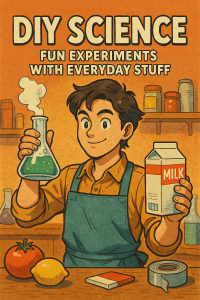
DIY science experiments for beginners do not need fancy equipment or a laboratory. Science is happening all around you, every day, in your kitchen, backyard, and even your junk drawer. Real learning begins when curiosity gets a little messy. If you want to spark a love for discovery and hands-on learning, these easy activities are perfect for diy science experiments for beginners.
DIY science experiments for beginners are about exploring with what you have on hand. You do not need expensive kits or complicated instructions. All you need is an open mind, a few household items, and a sense of adventure. Try these five simple experiments and see how much fun real science can be.
1. DIY Science Experiments for Beginners Water Can Walk and Carry Color
You can turn plain water into a rainbow with just a few cups, some paper towels, and a little food dye. Arrange six cups in a circle, fill every other cup with water and add food coloring. Place rolled-up paper towels so they connect each cup. Watch as the water creeps up the towels and carries the color over to the empty cups. This is capillary action, the same trick plants use to drink. DIY science experiments for beginners are all about bringing textbook concepts to life in a way you can see and touch.
2. Balloons Hate Citrus
Blow up a balloon and get an orange or lemon. Rub the peel and squeeze a little zest near the balloon. Pop. The balloon will burst without any sharp object. That is the power of limonene in citrus oils breaking down the rubber. DIY science experiments for beginners show how everyday chemistry can surprise and delight. No magic, just a little science with a bang.
3. Soap Turns Milk into a Lava Lamp
Pour some milk into a shallow dish, add drops of food coloring, then dip a cotton swab in dish soap and touch it to the milk’s surface. Instantly, colors swirl and dance. What you are seeing is surface tension breaking down and fat molecules moving away from the soap. DIY science experiments for beginners make chemistry as exciting as any magic show. You get wild patterns and a lesson on molecules in motion.
4. Invisible Ink Is Not Just for Spies
Write a secret message with lemon juice on white paper using a cotton swab. Let it dry. To reveal the message, hold the paper near a warm light bulb or over a toaster (with adult help). The words appear as brown lines. This is diy thermochromic magic. The heat oxidizes the lemon juice, turning it dark. DIY science experiments for beginners let you feel like a real spy while learning about chemical reactions and temperature changes.
5. Static Electricity Bends Water
Run a thin stream of water from a tap and blow up a balloon. Rub the balloon on your hair or a wool sweater to build up static charge. Bring the balloon near the stream and watch as the water bends toward it. Molecules in the water are drawn to the static charge. DIY science experiments for beginners make physics hands-on and fun. This is a perfect activity for a rainy afternoon.
DIY Science Experiments for Beginners Daily Practice
– Try a new experiment every week using only what you have at home
– Keep a science journal to record observations and questions
– Invite friends or family to join for double the fun and learning
– Take photos of each experiment and share your results online
– Explore further by asking Why did this happen and How else can I test it
DIY science experiments for beginners are more than just a way to pass the time. They build critical thinking, creativity, and a lifelong love of learning. Science gets exciting when you stop memorizing and start exploring for yourself.
🔬 Hands-On Science Kit:
Ready for real experiments at home? Dive into a world of discovery with this all-in-one science kit
👉 NATIONAL GEOGRAPHIC Earth Science Kit
Over 100 activities to grow crystals, make volcanoes, and get curious, no lab coat required.
📘 Want the full guide
Get the complete eBook
👉 DIY Science →
For even more fun experiments, visit Steve Spangler Science Lab Experiments trusted by teachers and curious minds everywhere